The central mixing plant (also known as central mix batch plant) is an automated concrete production equipment integrating raw material storage, precise metering, high-efficiency mixing, and finished product discharging. As a core facility in large-scale concrete production, the central mixing plant is widely used in ready-mixed concrete plants, large construction projects, and road & bridge construction—scenarios where the central mix batch plant’s stability and precision are highly valued.
Its core structure consists of three modules: main building section of the central mixing plant, background feeding system, and electric control system. The coordinated operation of each module ensures the efficiency and quality stability of the central mixing plant’s production.
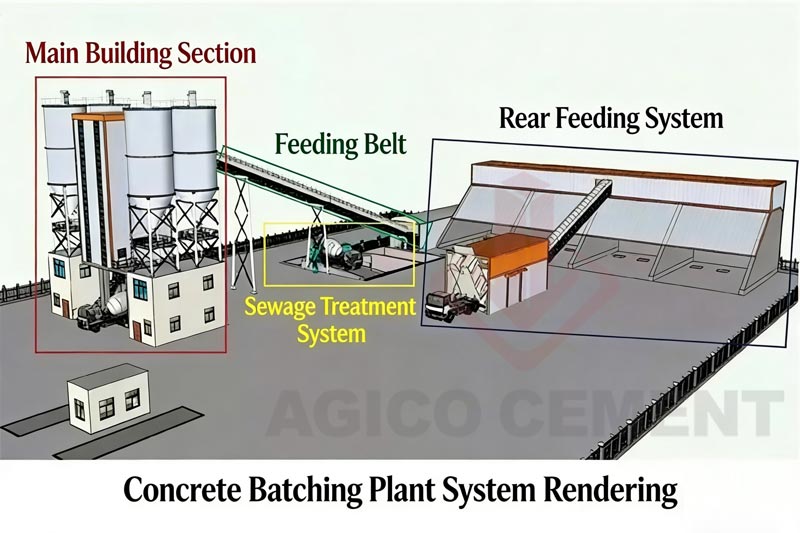
Structure of the Central Mixing Plant
Main Building of the Central Mixing Plant
The main building is the core working area of the central mixing plant, adopting a layered vertical layout. From bottom to top, it is successively composed of discharging layer, mixing layer, weighing layer, and aggregate temporary storage layer. The layers are connected by material conveying devices to realize the top-down circulation of materials, a design that optimizes the central mix batch plant’s space utilization and workflow.
1. Aggregate Temporary Storage Layer
Located at the top floor of the main building, it is a temporary storage and distribution unit for aggregates such as sand and gravel before entering the mixing process of the central mixing plant. It is mainly composed of multiple aggregate temporary storage bins, pneumatic discharge gates, arch-breaking devices, and bin top dust collectors.

During operation, the background feeding system transports sand and gravel aggregates to the corresponding temporary storage bins. According to the production formula, the pneumatic discharge gates open in a preset sequence, and the aggregates enter the lower weighing hopper through chutes—ensuring the central mix batch plant’s continuous material supply. The arch-breaking device can avoid arching and blockage of aggregates in the bins, while the bin top dust collector can reduce dust overflow, meeting the environmental protection standards required for modern central mixing plant operations.

2. Weighing Layer
As a key link of the central mixing plant to ensure concrete mix accuracy, it is also the core metering unit of the main building. This layer integrates three major metering modules: aggregate weighing hopper, powder weighing hopper, and liquid (water + admixture) weighing hopper. Each module is equipped with high-precision load cells and anti-interference devices, a critical configuration for the central mix batch plant’s propotion precision.

Aggregates fall from the temporary storage layer into the aggregate weighing hopper for rough metering; powder materials such as cement and fly ash are sent to the powder weighing hopper through screw conveyors; water and admixtures are transported to the corresponding liquid weighing hoppers by pumping systems. All materials are precisely measured according to the preset formula, with the metering error controlled within ±1%—a standard that defines the central mixing plant’s reliability in producing high-quality concrete.

3. Mixing Layer
It is the final mixing and forming area of concrete mixture, located directly below the weighing layer of the central mixing plant. The core equipment is a twin-shaft forced mixer (a vertical shaft planetary mixer can also be configured according to requirements), equipped with a motor, reducer, mixing blades, lubrication system, and discharging mechanism. For the central mix batch plant, the mixer’s performance directly determines the uniformity of the finished concrete.
After metering, all aggregate, powder, and liquid materials are sent to the mixer main machine in a preset feeding sequence. The mixing blades perform strong shearing and mixing on the materials during high-speed rotation to uniformly mix each component. The mixing time can be adjusted according to the concrete grade (generally 30-90 seconds). After mixing, the discharge gate of the mixer opens, and the finished concrete falls into the lower discharging hopper—completing the core mixing process of the central mixing plant.

4. Discharging Layer
It is the terminal discharging unit of the main building, directly docking with concrete mixer trucks to realize the central mixing plant’s material output. It is mainly composed of finished product discharging hopper, telescopic chute, and guide baffle.
After the mixed concrete falls into the discharging hopper, the telescopic chute can flexibly adjust the discharging height and angle according to the position of the mixer truck, and the guide baffle can prevent concrete spillage—ensuring fast and lossless discharging for the central mix batch plant. Some large-scale central mixing plants are also equipped with a vehicle positioning system at the discharging layer to ensure accurate docking of discharging and improve loading efficiency.

Background Feeding System of the Central Mixing Plant
The background feeding system is the “conveying hub” that supplies various raw materials to the main building of the central mixing plant. It is divided into three branch systems according to the material form: aggregate feeding, powder feeding, and liquid feeding, ensuring the continuous and stable supply of raw materials for the central mix batch plant.
1. Aggregate Feeding System
The mainstream configuration is a combination of belt conveyor + aggregate batching bin, and a bucket elevator can also be selected according to site restrictions. The aggregate batching bin stores different specifications of sand and gravel in advance, and the belt conveyor transports the aggregates to the aggregate temporary storage bin on the top floor of the main building. This system has the characteristics of large conveying capacity (up to 200-1000 t/h), low energy consumption, and simple maintenance—key advantages for the central mixing plant’s long-term operation.
2. Powder Feeding System
It is used to transport powder materials such as cement, fly ash, and mineral powder for the central mixing plant. The core equipment is a sealed screw conveyor, which is used with powder storage bins. The powder in the storage bin is pushed by the rotation of the screw blades of the screw conveyor, and the whole process is sealed for transportation to avoid moisture absorption and dust emission of the powder—meeting the environmental protection requirements of the central mix batch plant. Some large-scale central mixing plants are also equipped with a pneumatic conveying system to improve the efficiency and environmental friendliness of powder transportation.
3. Liquid Feeding System
It includes two independent systems: water storage tank + water pump and admixture storage tank + metering pump. Water and admixtures are stored in special storage tanks respectively, and are accurately transported to the liquid weighing hopper of the weighing layer by pumping equipment. The metering pump can realize the micro-precise transportation of admixtures to meet the needs of different concrete formulas for the central mixing plant and central mix batch plant.